
Do Email Tracking Pixels Hurt Deliverability?
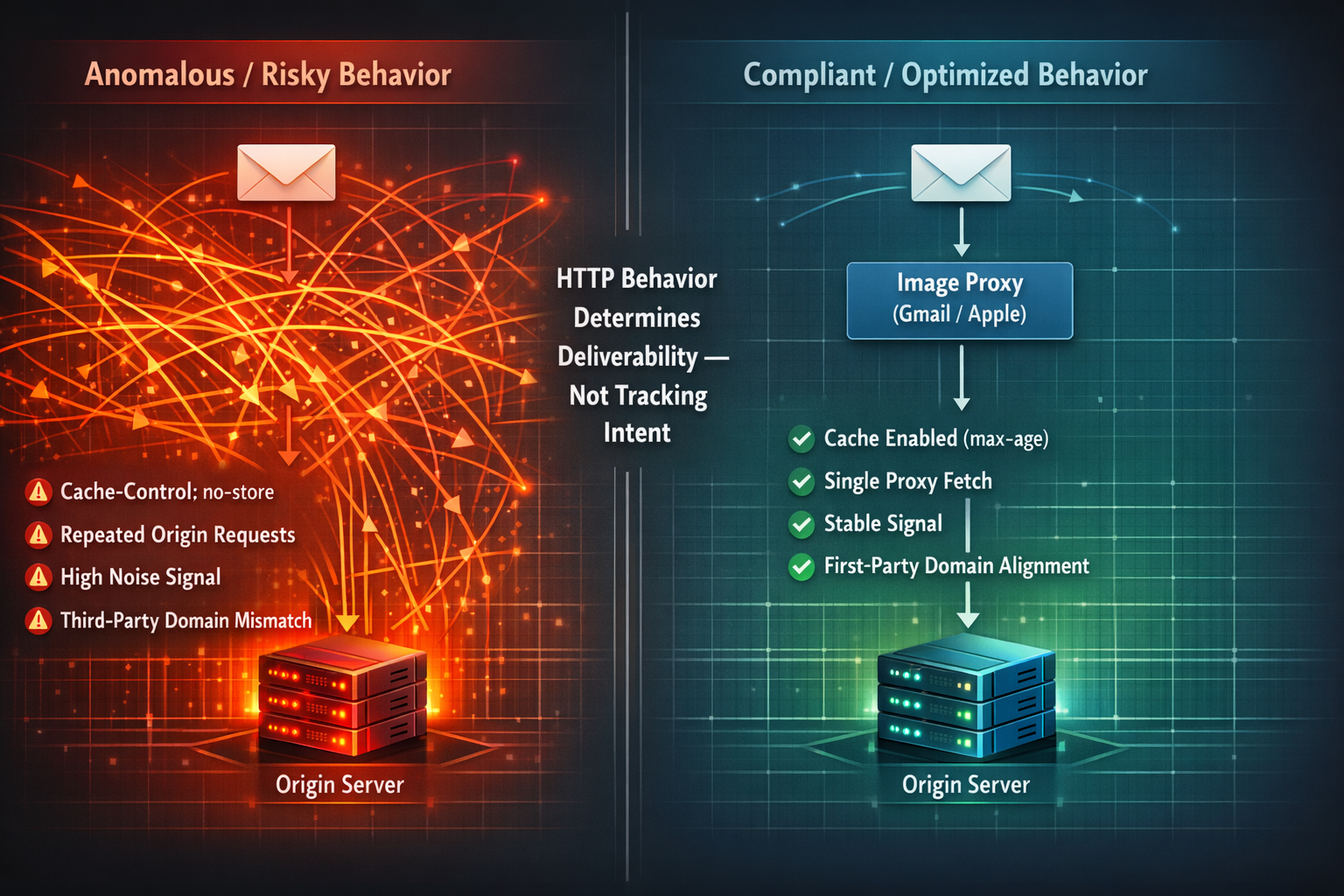
The long-standing debate over whether email tracking pixels trigger spam filters often misses a critical technical distinction. While many senders fear that the "tracking" nature of a pixel causes penalties, our infrastructure research suggests that the primary driver of classification is actually the underlying HTTP behavior of the resource.
The Protocol Over the Purpose
Modern email systems and classification engines evaluate message trust using observable infrastructure signals. A tracking pixel is, at its core, just a standard image resource requested via HTTP. Our testing showed that when a pixel is implemented with Cache-Control: no-store, it forces repeated origin requests every time a message is interacted with. This creates "high noise" and an "unstable signal" that mimics anomalous bot-like behavior to filtering systems.
In contrast, pixels configured for long-term caching (e.g., public, max-age=31536000) generate only a single proxy fetch. This "stable signal" drastically reduces the request frequency per open and aligns the pixel's behavior with that of legitimate, compliant web resources.
The First-Party Trust Factor
One of the most significant deliverability risks identified in our study was domain misalignment. When a tracking pixel is hosted on a third-party domain that differs from the sender's domain, it introduces a "detectable trust inconsistency". This cross-domain request can be flagged by modern security filters as a suspicious external resource call.
By moving tracking infrastructure to a first-party aligned domain—where the pixel's URL matches the sender's authenticated domain—the resource call becomes a "consistent trust signal". In our controlled tests, these aligned implementations resulted in neutral classification outcomes, regardless of the tracking intent.
How Proxies Protect Compliant Senders
The introduction of the Gmail Image Proxy and Apple Mail Privacy Protection has changed the landscape of deliverability. While these systems obscure user data like IP addresses, they also serve as a protective buffer for senders. Because proxy systems cache images aggressively, they reduce the number of direct requests to the sender’s infrastructure.
For a compliant, cache-aware implementation, the Gmail proxy fetch occurs only once per message. This reduces the "noise" that might otherwise trigger rate-limiting or reputation penalties at the network level. Our research confirms that tracking pixels do not introduce negative deliverability signals when implemented correctly; rather, classification systems respond to the deviations from standard HTTP best practices.

MailPing conducts independent analysis of Gmail infrastructure, proxy image retrieval systems, and modern email tracking behavior through controlled testing and research.