
How Gmail’s Image Proxy Works (Complete Technical Breakdown)
Many email tracking systems rely on a simple mechanism: detecting when an image loads inside an email message. When that image is requested from the sender’s server, the system records the event as an email open.
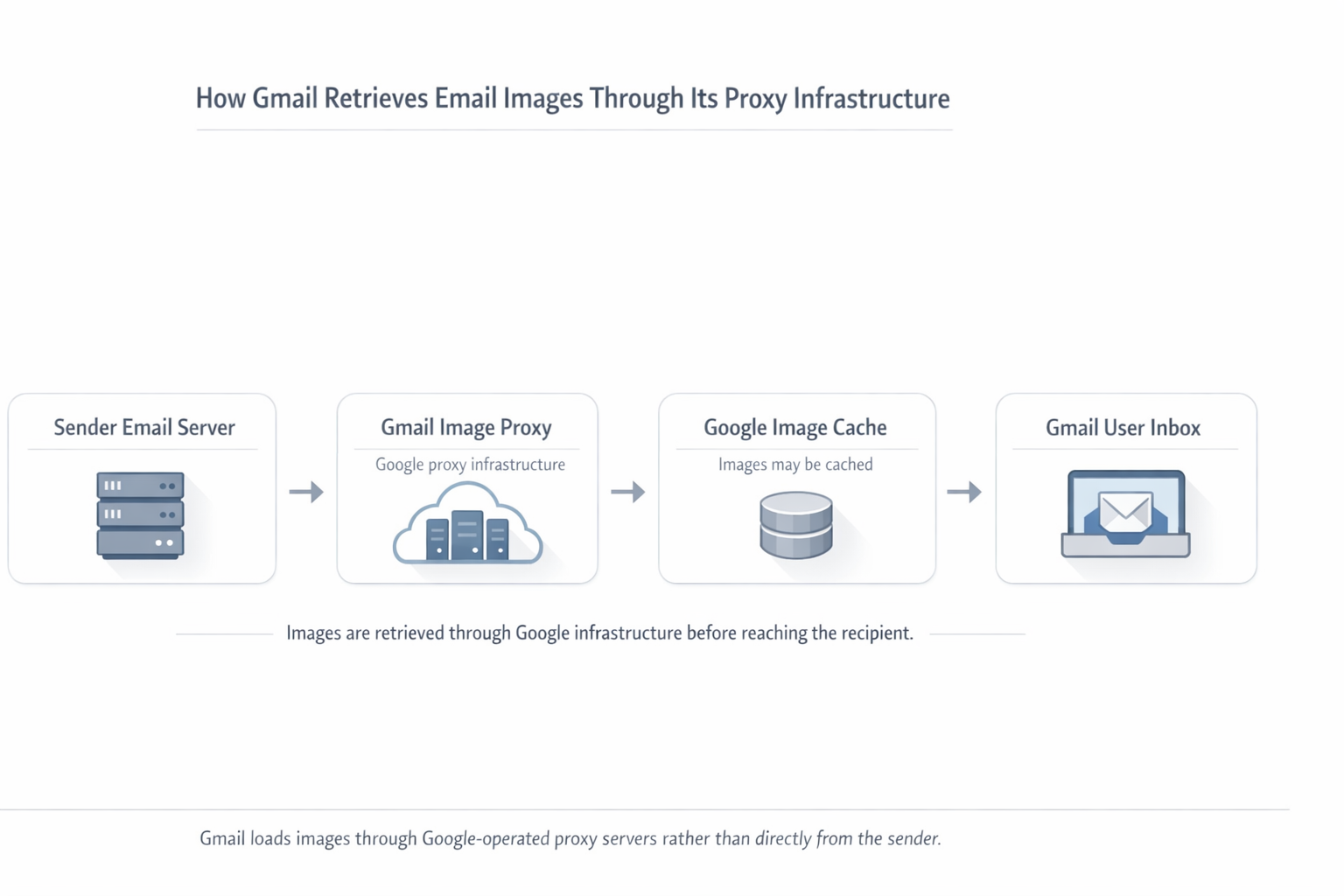
However, Gmail’s image proxy means images are not loaded directly from the sender’s server. Instead, Gmail retrieves images through proxy infrastructure operated by Google. This architectural layer changes how image requests appear and can influence how email tracking signals are interpreted.
Understanding how Gmail’s image proxy works is essential for anyone analyzing engagement signals in Gmail environments. A broader explanation of how Gmail mediates image retrieval, filtering, and engagement signals across its platform can be found in the Gmail Infrastructure Guide. For a general overview of email tracking methods see Can You Track Emails in Gmail? .
Why Gmail Uses an Image Proxy
Google introduced its image proxy system to improve both security and privacy for Gmail users.
When Gmail encounters images embedded inside an email, the images may first pass through Google’s proxy infrastructure before reaching the user’s inbox. This allows Gmail to scan images for malicious content and reduce direct exposure between sender servers and recipient devices.
- Security scanning of remote images
- Protection of recipient IP addresses
- Improved performance through image caching
- Centralized filtering and content inspection
These benefits improve the safety and performance of Gmail, but they also introduce an additional infrastructure layer between the sender and the recipient. This proxy architecture is also why Gmail hides the recipient’s network identity from senders, as explained in our investigation of which email clients reveal recipient IP addresses.
How Gmail Retrieves Email Images
When a Gmail user opens a message that contains images, the retrieval process typically follows several steps.
- The recipient opens the email in Gmail
- Gmail identifies external images embedded in the message
- Google proxy servers request the image from the original host
- The image is delivered to the user through Gmail’s infrastructure
Because the request is routed through Google’s systems, the sender’s server may see image requests originating from Google infrastructure rather than from the recipient’s device.
Gmail Image Caching
Another important characteristic of Gmail’s proxy architecture is image caching.
After Gmail retrieves an image, the system may temporarily store the image in Google’s infrastructure. Subsequent views of the same email may retrieve the cached image instead of requesting it again from the sender’s server.
This behavior can influence how often tracking pixels are requested and may affect how open events are recorded.
Where Image Requests Appear to Come From
Because Gmail acts as an intermediary between the sender and the recipient, image requests often originate from Google infrastructure rather than from the user’s device.
Tracking systems may therefore observe:
- Image requests from Google-owned IP ranges
- Geographic locations associated with Google data centers
- Requests that do not match the recipient’s device location
These behaviors sometimes lead to confusion when analyzing engagement signals. A deeper explanation of how this affects tracking results can be found in Why Gmail Email Opens Are Often Wrong (Gmail Image Proxy Explained) .
How the Proxy Changes Email Tracking
Most email tracking systems treat an image request as evidence that a message has been opened. Gmail’s proxy architecture complicates that interpretation.
Because Gmail mediates image retrieval, tracking systems may record events triggered by infrastructure behavior rather than direct user interaction.
This behavior has been confirmed in controlled infrastructure testing. In the
Email Client Protocol Study – Gmail vs Apple vs Outlook
,
MailPing observed that Gmail generates a proxy-based image request before user interaction, whereas Apple Mail only loads images at open and Outlook loads images directly from the recipient device.
This distinction defines why Gmail tracking signals can appear before an email is actually opened — and more importantly, why tracking accuracy depends on how these signals are interpreted. A deeper explanation of this can be found in
The Email Tracking Problem Isn’t the Data — It’s the Interpretation
.
This is one of the reasons email open tracking sometimes appears inconsistent. A broader explanation can be found in How Accurate Is Gmail Email Tracking? .
Does Gmail Block Email Tracking?
A common misconception is that Gmail blocks tracking pixels entirely.
In reality, Gmail usually allows images to load but retrieves them through proxy infrastructure. This architectural change modifies how signals appear rather than eliminating them completely.
A more detailed explanation of this misconception can be found in Does Gmail Block Email Tracking? .
Infrastructure Layers in Modern Email
Modern email systems often involve multiple infrastructure layers between the sender and the recipient. Gmail’s proxy architecture is one example of this broader shift toward intermediary processing layers in communication systems.
For domain-based email, Gmail may also function as the interface or backend infrastructure for sending and receiving messages. This relationship is explored in Gmail Has Quietly Become Infrastructure for Custom Domain Email .
As email platforms continue to evolve, interpreting engagement signals increasingly requires an understanding of how infrastructure mediates communication. A deeper technical breakdown of how Gmail proxy infrastructure influences tracking behavior can be found in How Gmail’s Image Proxy Affects Email Tracking .

MailPing conducts independent analysis of Gmail infrastructure, proxy image retrieval systems, and modern email tracking behavior through controlled testing and research.