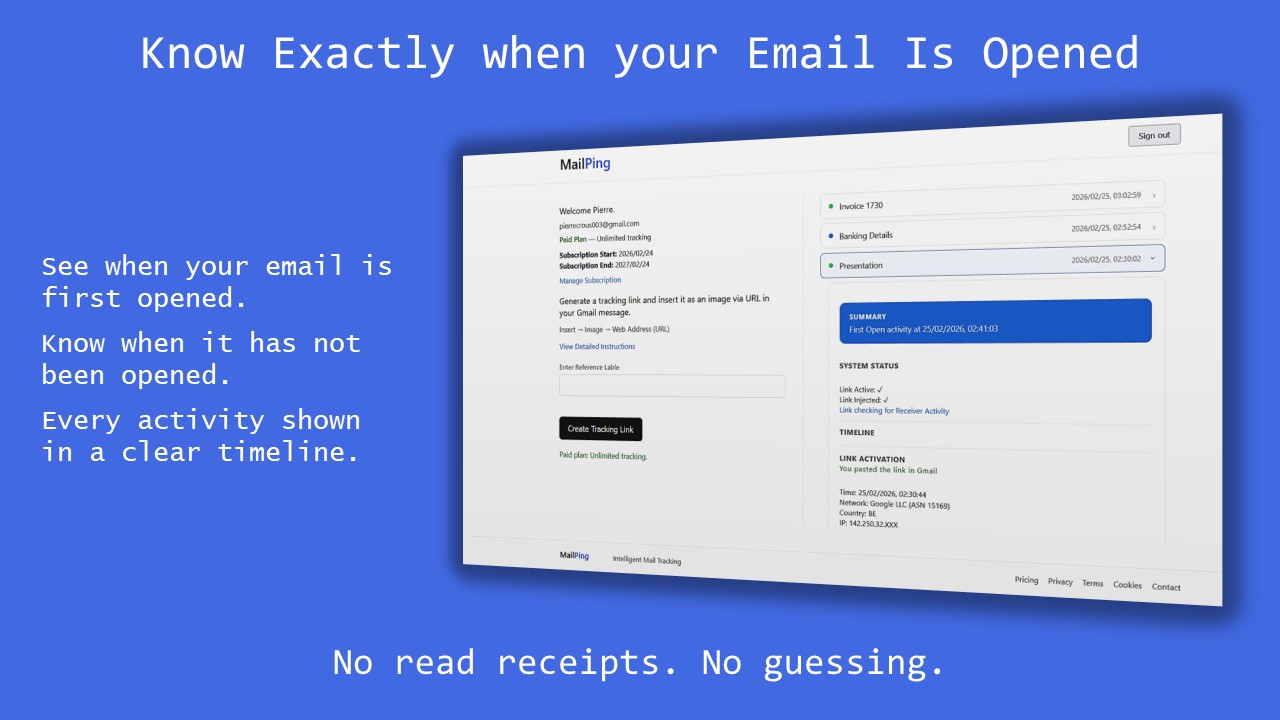
Mailtrack vs. MailPing: Why Proxy Awareness is the Key to Accuracy
Last updated:
Short Answer: The biggest difference is how these tools handle the Google Image Proxy. While Mailtrack often records "false opens" triggered by automated servers, MailPing is proxy-aware, filtering out bot traffic to ensure you only see real human engagement.
Quick Summary:
- Mailtrack requires full "Read/Write/Delete" inbox permissions; MailPing requires none.
- Automated extensions often trigger false positives upon sending.
- MailPing identifies and ignores Google Image Proxy pre-fetch events.
- Manual insertion provides 100% control over which emails are tracked.
If you have ever sent an email and received an "Open" notification within 0.5 seconds, you have encountered the biggest problem in modern email tracking: the Proxy Ping. Popular browser extensions like Mailtrack are often "blind" to the difference between a real person opening your email and a Google server pre-scanning your images. This leads to inflated metrics and false hope.
The False Open Problem Explained
When you send an email to a Gmail user, Google’s infrastructure often "pre-fetches" the images in that email to cache them on their own servers. To a standard tracking pixel, this look exactly like an open event. This is why Gmail opens appear from Google IP addresses. Mailtrack and similar extensions struggle to filter these out because they prioritize volume over precision. MailPing was designed with a "Proxy Aware" architecture. We analyze the incoming request headers and IP behavior to distinguish between a Google bot and a human user, ensuring your tracking accuracy remains high.
Privacy: Inbox Access vs. Identity Only
One of the most overlooked risks of using Gmail extensions is the level of permission they require. To function, Mailtrack typically asks for full access to "Read, compose, send, and permanently delete all your email from Gmail." For many users, this is a massive security red flag. MailPing takes a fundamentally different approach. We use Google Identity Services (GIS) solely for account creation. We never ask for, and never have access to, your inbox content. Because you manually insert the tracking link into your message using the "Insert Image by URL" method, we don't need a browser extension to "spy" on your drafts.
Intentional Tracking vs. Always-On Noise
Automated trackers track everything—even your personal family threads or sensitive bank emails. This creates unnecessary data clutter and privacy concerns. MailPing is built for intentional, high-stakes communication. By generating a specific link in your dashboard and pasting it into your message, you are making a deliberate choice to monitor that specific thread. This "manual" step is a powerful privacy feature, ensuring you never track an email by accident. It is the best tracking method for users who value precision over automated "set and forget" systems that often fail in the background.