
The Email Tracking Problem Isn’t the Data — It’s the Interpretation
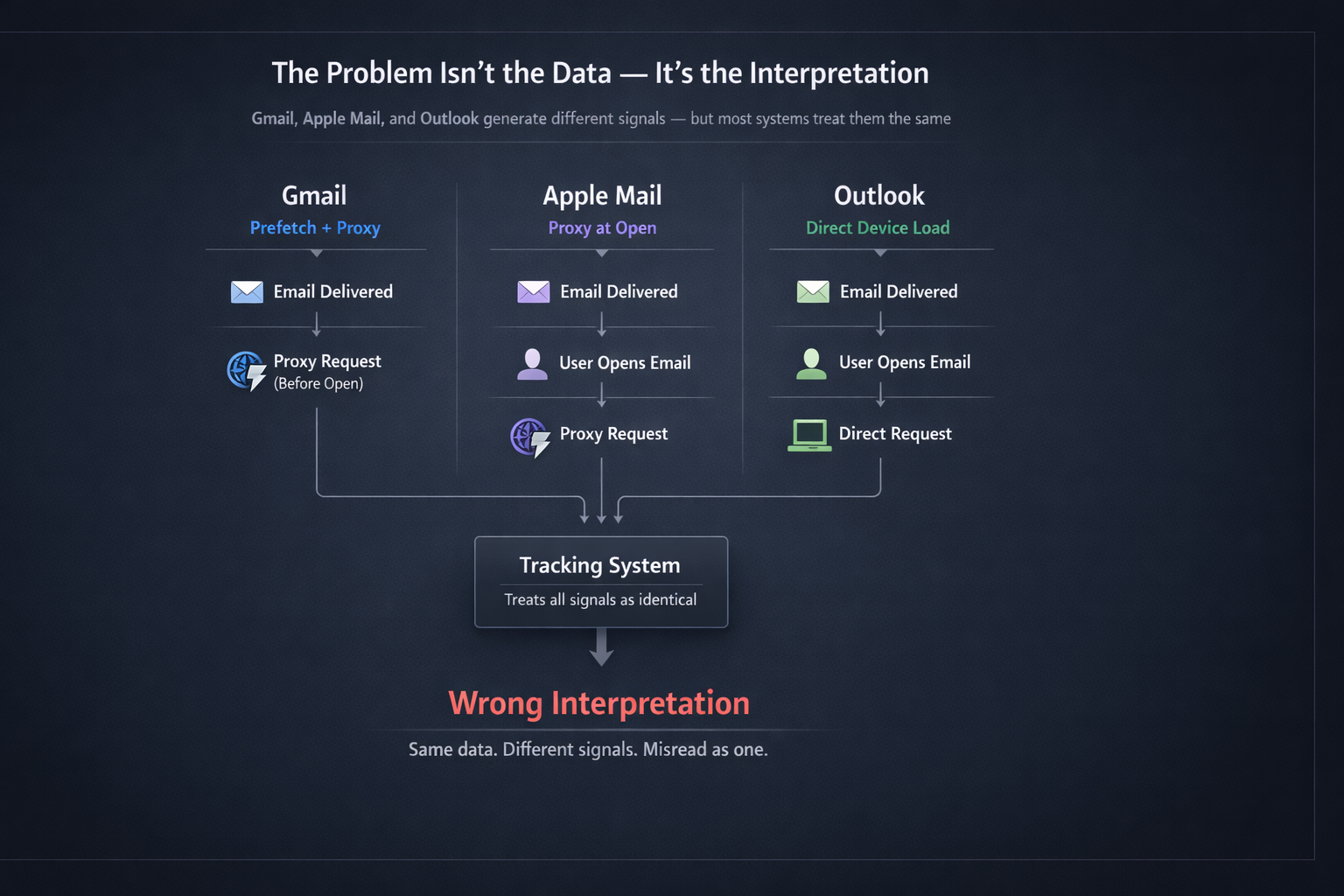
Email tracking hasn’t failed. The data hasn’t become unreliable. What’s broken is how most systems interpret the signals generated by modern email clients.
Why Email Tracking Feels Inconsistent
Marketers and sales teams often see conflicting results across platforms. Gmail appears to generate early opens, Apple Mail hides user data, and Outlook behaves differently again. This leads to the assumption that tracking itself is flawed.
But these inconsistencies are not errors — they are the result of fundamentally different infrastructure behaviors. As shown in the MailPing research study Email Client Protocol Study, each client produces a distinct type of tracking signal that must be interpreted correctly.
For deeper context on Gmail-specific behavior, see why Gmail email opens are often wrong and how Gmail image proxy works.
Three Clients. Three Completely Different Signals.
Gmail generates a proxy request before user interaction, a behavior commonly misunderstood as a false open. Apple Mail loads images only when the user opens the email, but routes requests through its privacy proxy. Outlook loads images directly from the recipient’s device, producing a clear user-origin signal.
These are not variations of the same signal — they are entirely different signal types. Treating them as equivalent is where most tracking systems fail.
For a breakdown of Gmail’s infrastructure layer, see Gmail infrastructure guide.
Where Most Tracking Systems Go Wrong
Most platforms treat every first image request as a user open. They do not distinguish between prefetch behavior, proxy-based requests, and direct device loads.
This leads to inflated engagement in Gmail, anonymized signals in Apple Mail, and inconsistent comparisons across platforms. The issue is not the signal itself — it is the failure to classify it correctly.
MailPing resolves this by analyzing the first receiver-side request and identifying its origin and timing. This allows accurate interpretation across Gmail, Apple Mail, and Outlook without relying on assumptions.
This interpretation problem is reinforced by MailPing deliverability research showing that tracking accuracy and classification outcomes are determined by how tracking pixels are implemented at the HTTP level, not by the presence of tracking itself. See Email Tracking Pixel Implementation Study.
For more on Gmail tracking accuracy, see how accurate Gmail email tracking is.

MailPing conducts independent analysis of Gmail infrastructure, proxy image retrieval systems, and modern email tracking behavior through controlled testing and research.