
Gmail Infrastructure: How Gmail Processes Modern Email
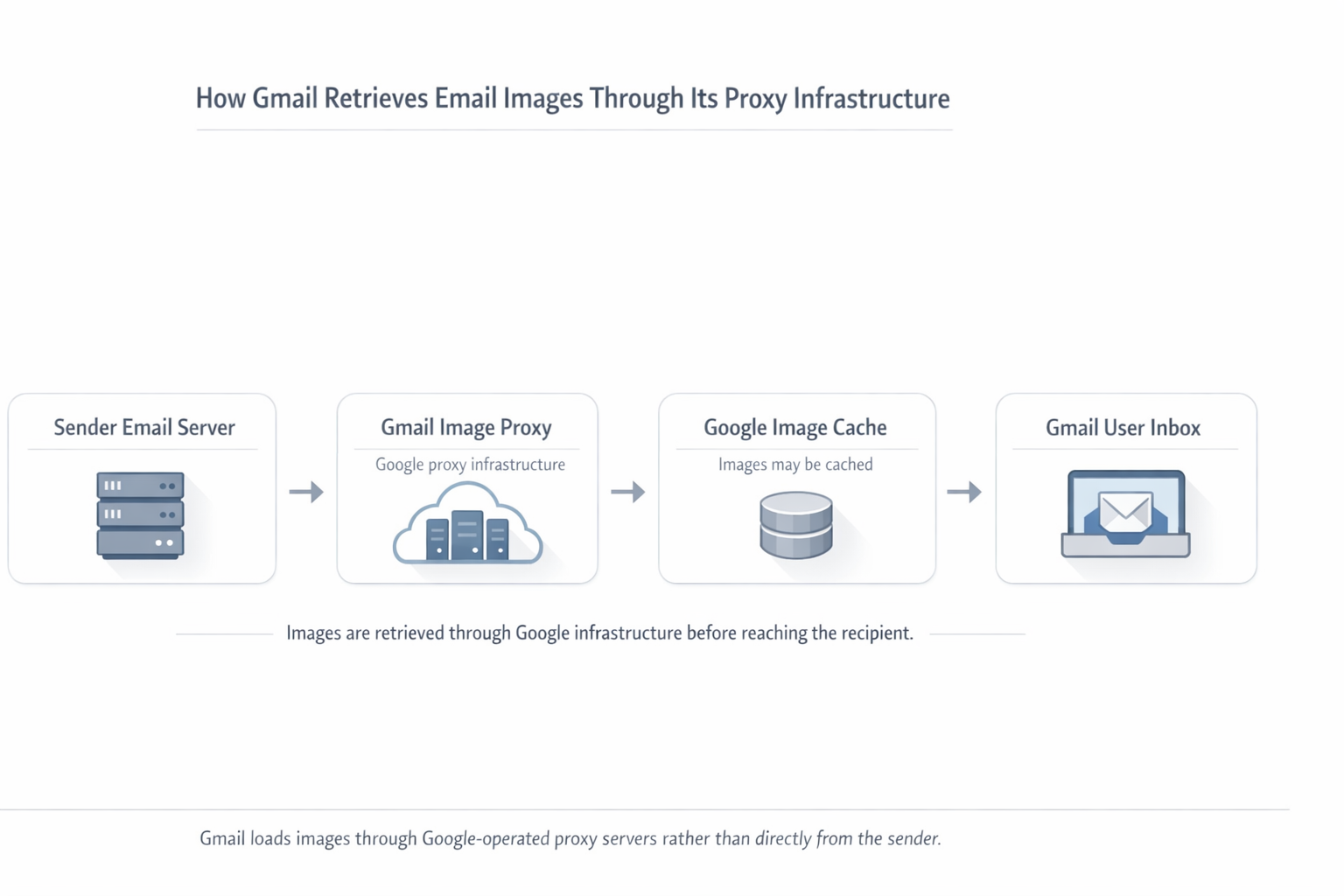
Gmail is often perceived simply as an email client. In practice, the platform functions as a large-scale infrastructure layer that processes messages, retrieves images, filters content, and mediates communication between senders and recipients. This guide provides a technical overview of how Gmail infrastructure works and how its systems influence email tracking behavior.
Because Gmail sits between multiple systems in the delivery chain, many signals commonly used to interpret email engagement are influenced by Gmail’s infrastructure rather than by direct user interaction.
Understanding how Gmail processes email therefore requires examining the infrastructure layers that operate behind the inbox interface.
Several components of Gmail’s infrastructure influence how email signals behave in practice. The sections below examine key systems including image proxy retrieval, tracking signal interpretation, and domain-based email routing across Gmail’s platform.
The Infrastructure Layers Behind Gmail
Modern email communication often passes through several technical layers before reaching the recipient. Gmail may participate in multiple stages of this process depending on how the message is sent and how the inbox retrieves content.
- Email delivery infrastructure
- Spam filtering systems
- Image proxy retrieval
- Image caching and rendering
- Domain email routing and SMTP authentication
These layers affect how messages are processed, how images are loaded, and how engagement signals appear to tracking systems.
Gmail Image Proxy Infrastructure
One of the most visible infrastructure layers is Gmail’s image proxy system. Instead of loading images directly from the sender’s server, Gmail retrieves external images through Google-controlled proxy servers.
This architecture helps protect user privacy, scan remote images for malicious content, and improve performance through caching. As shown in our analysis of which email clients reveal recipient IP addresses, Gmail’s proxy infrastructure prevents senders from directly observing a user’s network identity.
A detailed explanation of this system can be found in How Gmail’s Image Proxy Works.
How Gmail Influences Email Tracking Signals
Because Gmail retrieves images through intermediary infrastructure, tracking signals sometimes reflect infrastructure activity rather than direct user interaction.
Image requests may originate from Google data centers rather than from the recipient device, and cached images may be reused across multiple views.
These behaviors are examined in
How Accurate Is Gmail Email Tracking?.
However, the critical factor is not the presence of these signals — it is how they are interpreted. A deeper explanation of this can be found in
The Email Tracking Problem Isn’t the Data — It’s the Interpretation
,
which explains how Gmail, Apple Mail, and Outlook each produce fundamentally different signal types.
Domain Email and Gmail Infrastructure
Many organizations send email from custom domain addresses while still relying on Gmail as the operational interface.
In some cases Gmail hosts the domain directly through Google Workspace. In other configurations Gmail connects to external mail servers using SMTP authentication.
An analysis of these configurations can be found in Gmail Has Quietly Become Infrastructure for Custom Domain Email.
Gmail “Send Mail As” Architecture
Gmail’s “Send Mail As” feature allows users to send messages from external domain addresses while composing messages within Gmail’s interface.
This configuration separates identity from infrastructure: the visible domain belongs to the sender, while Gmail provides the interface and routing environment.
The infrastructure behind this configuration is explained in How Gmail “Send Mail As” Works With Custom Domain Email.
Infrastructure vs Human Activity
When infrastructure layers mediate communication, signals generated by systems may be mistaken for direct user interaction.
This distinction is particularly important when analyzing email engagement metrics such as open detection, image rendering, and message delivery behavior.
The Growing Role of Gmail as Email Infrastructure
Over time Gmail has evolved from a standalone inbox into a shared infrastructure layer used by millions of individuals, businesses, and domain-based email systems.
Even when a message appears to originate from a custom domain, Gmail may still participate in filtering, image retrieval, or message rendering.
As a result, understanding Gmail’s infrastructure has become increasingly important for developers, marketers, and analysts working with email data.

MailPing conducts independent analysis of Gmail infrastructure, proxy image retrieval systems, and modern email tracking behavior through controlled testing and research.