
How Accurate Is Gmail Email Tracking?
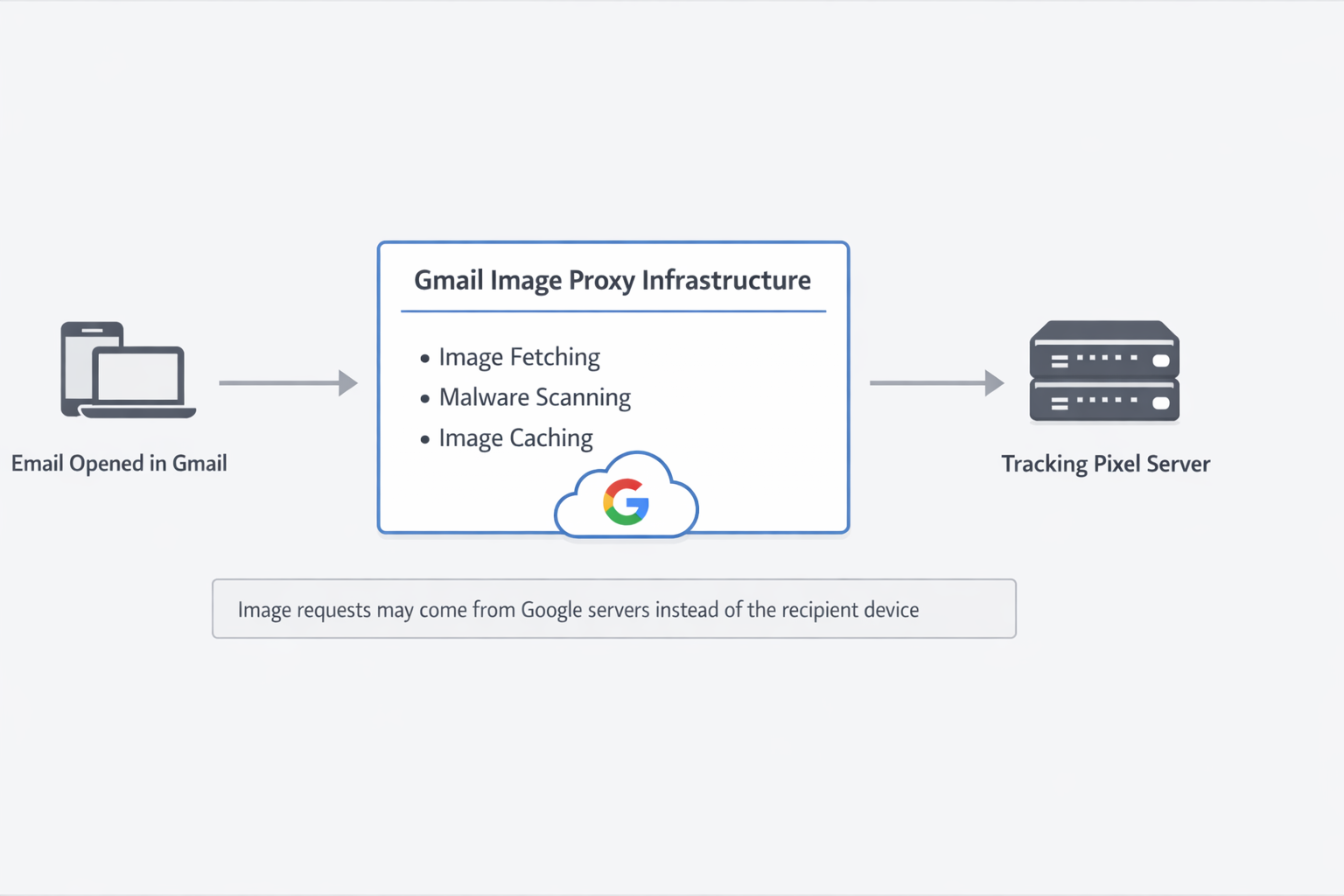
Email tracking is widely used to measure engagement in marketing, sales, and customer communication workflows. Most tracking systems rely on a small invisible image known as a tracking pixel to detect when a message is opened.
However, Gmail retrieves images through proxy infrastructure rather than loading them directly from the sender’s server. Because of this architecture, tracking signals can sometimes appear inaccurate or inconsistent. A broader technical explanation of how Gmail mediates image retrieval, filtering, and tracking behavior can be found in the Gmail Infrastructure Guide.
If you are new to email tracking in Gmail, a broader overview can be found in Can You Track Emails in Gmail? , which explains the different approaches used to detect when messages are opened.
Why Gmail Email Tracking Is Different
Gmail’s infrastructure differs from many traditional email clients. Instead of allowing direct image requests between the recipient device and the sender’s server, Gmail introduces an intermediary proxy layer.
This architecture improves security and performance but changes how tracking signals appear to analytics systems. As a result, open tracking data may reflect infrastructure behavior rather than direct user interaction.
How Email Tracking Normally Works
Most email tracking systems embed a tiny image inside the email. When the recipient opens the message and images load, the email client requests that image from the sender’s server.
That request confirms that the email content has been rendered.
Gmail’s Image Proxy System
Unlike many email clients, Gmail loads images through proxy infrastructure operated by Google. When Gmail encounters an image inside an email, the request is routed through Google’s servers before reaching the original image host.
This system scans images for security threats and may cache images before delivering them to the recipient’s inbox.
Because these requests can originate from Google infrastructure rather than the recipient’s device, tracking signals sometimes appear unusual. This proxy behavior also prevents senders from seeing the recipient’s real network identity, which is explored in our analysis of which email clients reveal recipient IP addresses.
This behavior is closely related to Gmail’s image proxy architecture. A detailed explanation of how Gmail’s proxy system influences open signals can be found in Why Gmail Email Opens Are Often Wrong (Gmail Image Proxy Explained).
A deeper explanation of Gmail’s proxy behavior can be found in How Gmail’s Image Proxy Affects Email Tracking .
Why Gmail Tracking Can Look Inaccurate
- Image requests may originate from Google servers
- Images may be cached and reused
- Multiple requests may occur for the same image
- Requests may occur before a user reads the message
These behaviors sometimes cause tracking systems to report open events that appear earlier than expected or originate from locations associated with Google infrastructure.
This behavior has been validated through controlled infrastructure testing. In the
Email Client Protocol Study – Gmail vs Apple vs Outlook
,
MailPing observed that Gmail generates a proxy-based image request before user interaction, while Apple Mail only loads images at open and Outlook loads images directly from the recipient device. This confirms that Gmail tracking signals can occur before a user actually opens the email, which is the primary reason accuracy appears inconsistent.
However, the issue is not that email tracking is inherently inaccurate — it is that different email clients generate different types of signals that must be interpreted correctly. A deeper explanation of this can be found in
The Email Tracking Problem Isn’t the Data — It’s the Interpretation
,
which explains how Gmail, Apple Mail, and Outlook each produce fundamentally different tracking behaviors.
Does Gmail Block Email Tracking?
Gmail does not completely block tracking pixels. Instead, Gmail mediates how images are retrieved through proxy infrastructure.
For senders using custom domain addresses, tracking behavior can also depend on the infrastructure used to send the message. A technical explanation is available in How to Track Email From Your Own Domain .
For a deeper explanation see Does Gmail Block Email Tracking? .
Understanding Engagement Signals
Modern email analytics must distinguish between infrastructure-level events and real user engagement. An image request confirms that content was rendered somewhere in the delivery chain, but it does not always guarantee that a human viewed the message at that moment.
For users trying to monitor engagement more accurately, different tracking approaches exist depending on the email client and infrastructure involved. A detailed comparison can be found in Best Gmail Email Tracking Methods .
MailPing separates infrastructure-origin image requests from recipient-side activity when determining delivery and open signals.
The Future of Email Tracking Accuracy
Email tracking continues to evolve as major email platforms introduce new infrastructure layers focused on security and privacy.
Proxy systems, caching behavior, and privacy protections mean that engagement signals must be interpreted with greater care than in the early days of email analytics.
Understanding how platforms like Gmail process images helps explain why tracking signals sometimes appear inconsistent — and why interpreting those signals requires more than simply counting image requests.

MailPing conducts independent analysis of Gmail infrastructure, proxy image retrieval systems, and modern email tracking behavior through controlled testing and research.