
Gmail Has Quietly Become Infrastructure for Custom Domain Email
Over the past decade, Gmail has evolved far beyond a personal inbox. With more than a billion active users and widespread adoption of Google Workspace, the platform now functions as backend infrastructure for millions of domain-branded addresses worldwide.
Increasingly, freelancers, small businesses, and established companies rely on Gmail as the operational layer behind their custom domain email — a shift that has been gradual and largely invisible to recipients.
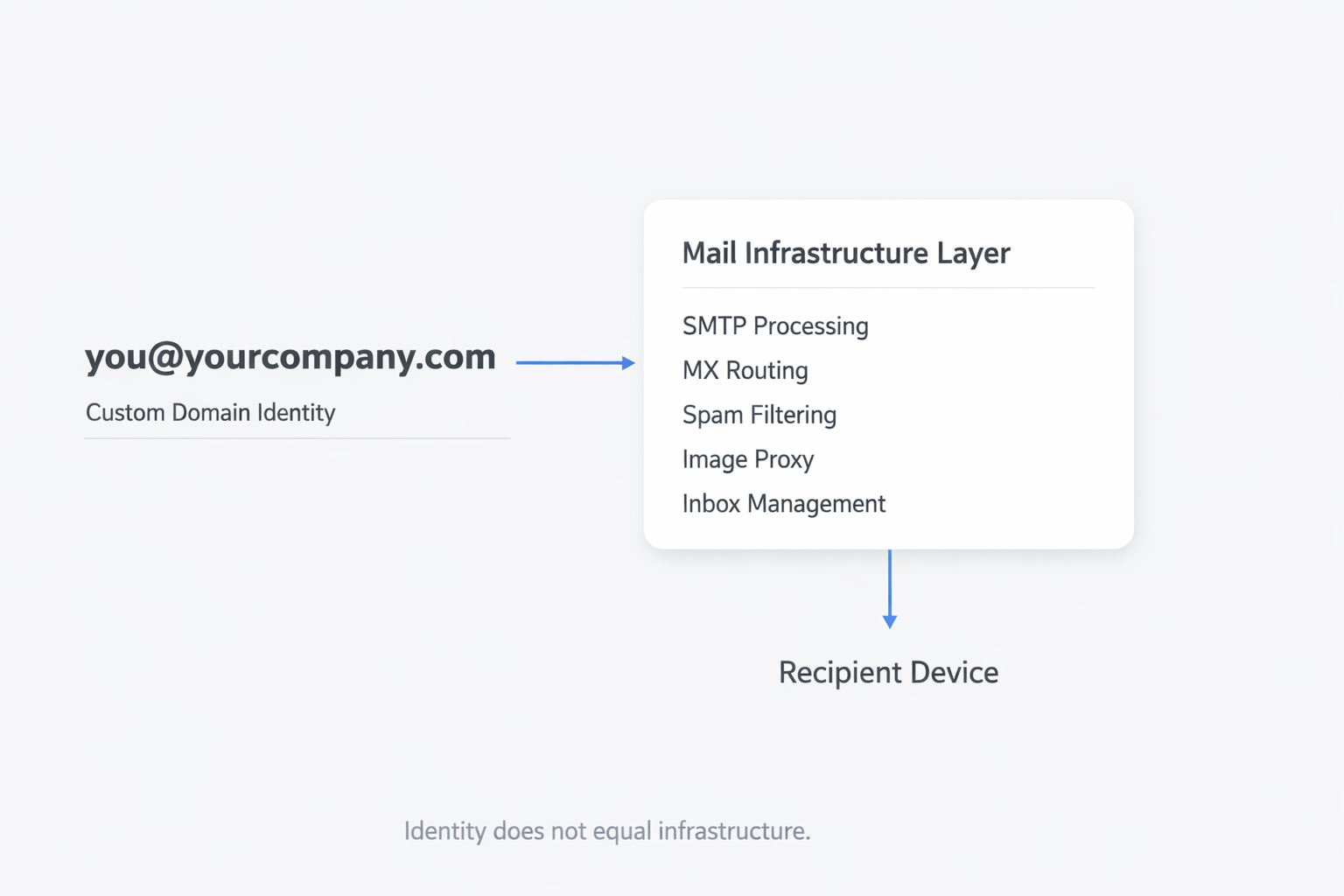
To recipients, messages appear to come from [email protected]. Behind the scenes, however, Gmail often handles sending, filtering, image proxying, and inbox management.
A broader technical overview of how Gmail processes email delivery, image retrieval, and engagement signals across the ecosystem can be found in the Gmail Infrastructure Guide .
The Three Most Common Setups
1. Full Hosting via Google Workspace
Through Google Workspace, businesses connect their domain directly to Gmail’s servers. Google becomes the official mail host, managing MX records, authentication, and delivery.
2. Gmail “Send Mail As” (SMTP Alias)
Many domain owners host email elsewhere but configure Gmail to send messages on behalf of that domain using SMTP credentials. The domain identity remains intact, while Gmail provides the interface and operational environment.
3. Inbox Aggregation via POP/IMAP
Some users retain domain hosting externally but pull incoming mail into Gmail using POP3 or IMAP retrieval. Gmail becomes the functional inbox layer.
Infrastructure vs Identity
Domain branding does not necessarily mean domain-level infrastructure. When messages pass through Gmail’s ecosystem, image requests and tracking pixels are frequently fetched through Google-controlled proxy systems before reaching the end device.
When messages pass through Gmail’s ecosystem, image requests and tracking pixels are frequently fetched through Google-controlled proxy systems before reaching the end device. The behavior of these systems is explained in How Gmail’s Image Proxy Works.
To the outside world, a domain name signals ownership and independence. Technically, however, control often sits elsewhere. When Google’s systems mediate sending, receiving, filtering, and image rendering, the operational layer effectively belongs to Google — even if the visible email identity belongs to the domain owner.
This distinction affects deliverability reputation, authentication alignment (SPF, DKIM, DMARC), image caching behavior, and interpretation of open signals.
Systems that analyze email engagement must therefore understand not only the domain identity of a message, but also the infrastructure through which the message is processed. Tools such as MailPing attempt to account for these infrastructure layers when interpreting tracking signals.
Quiet Standardization
A substantial portion of small-to-mid-sized domain email now runs through Google’s infrastructure — either directly via Google Workspace or indirectly through Gmail-based routing and aggregation.
The result is a form of backend standardization. Independent domains increasingly rely on a shared technical backbone, even as branding suggests independence.
For many operators, this consolidation simplifies management. For others, it introduces a new form of dependency. When infrastructure centralizes, performance, filtering behavior, image handling, and even subtle engagement signals become mediated by a single platform.
The tradeoff is convenience in exchange for infrastructure sovereignty — a calculation that millions of domain owners appear willing to make.
Why Adoption Continues to Grow
- Familiar interface
- Strong spam filtering
- Reliable global delivery
- Low operational complexity
- Seamless mobile synchronization
For small teams and independent operators, Gmail provides enterprise-grade infrastructure without the operational overhead typically associated with mail servers.
As domain-based email adoption continues to expand, the distinction between brand identity and technical infrastructure will become more relevant — not less. For developers, marketers, and operators measuring engagement, deliverability, or open behavior, understanding the underlying platform is no longer optional.

MailPing conducts independent analysis of Gmail infrastructure, proxy image retrieval systems, and modern email tracking behavior through controlled testing and research.